
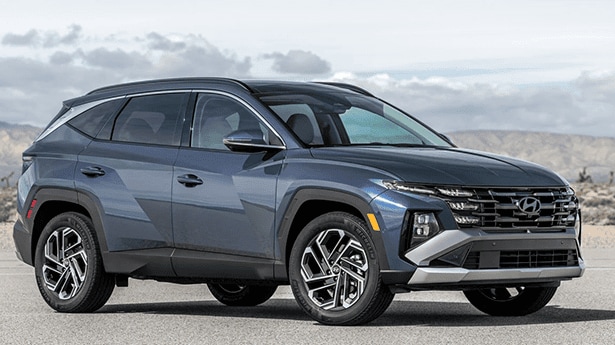
The 2026 Hyundai Tucson delivers better value, stronger hybrid performance, higher towing limits, and superior technology than the 2026 Honda CR-V. With a standard 2,000 lbs towing capacity across gas and hybrid models, an available 231 hp hybrid powertrain, standard dual 12.3-inch panoramic displays, and a 10-year/100,000-mile powertrain warranty, the Tucson surpasses the CR-V in capability, interior tech, and long-term ownership protection.
Choosing between these two compact crossover leaders comes down to standard equipment and real-world versatility. While the Honda CR-V has long been a staple in the segment, the updated 2026 Hyundai Tucson brings significant advantages that appeal directly to practical SUV shoppers. Drivers navigating daily highway travel along I-271 through Bedford appreciate how Hyundai equips every trim level with premium safety technology, refined cabin materials, and dynamic performance features without requiring buyers to move into higher trim levels.
A major point of distinction is towing capability. The 2026 Hyundai Tucson offers a towing capacity of 2,000 lbs across both its traditional gas engine and hybrid variants when properly equipped. In contrast, the standard 2026 Honda CR-V gas model tops out at 1,500 lbs, while the CR-V Hybrid drops to just 1,000 lbs. For families hauling small utility trailers, personal watercraft, or pop-up campers for weekend outings, the Tucson provides the extra margin of utility required for active lifestyles.
When you compare standard tech and passenger accommodations, the Tucson continues to pull ahead. Hyundai includes wireless smartphone connectivity alongside dual high-resolution displays, ensuring seamless navigation and entertainment. To test these capabilities in person, stop by our Rockside Road showroom or give our sales team a quick call to learn more about current availability.
What Is the Price Difference and Value Profile of the 2026 Tucson vs. CR-V?
The 2026 Hyundai Tucson provides a lower entry price and a far more comprehensive standard feature list across its trim lineup than the 2026 Honda CR-V. Starting with the well-equipped SE trim and moving through the SEL, XRT, and Limited, Hyundai offers more horsepower, larger infotainment screens, and longer warranty coverage at every comparable price point.
Value in the crossover segment is measured by what comes standard on base and mid-level trims. The entry Tucson SE includes features that require expensive package upgrades on the CR-V LX. For example, Hyundai equips the Tucson with standard Proactive Driving Assist, Blind-Spot Collision Warning, and Rear Cross-Traffic Collision-Avoidance Assist. The CR-V limits several advanced driver-assist features to its higher trims or charges extra as standalone options.
- Standard Powertrain: Tucson equips a 2.5L 4-cylinder engine delivering 187 hp and 178 lb-ft of torque, paired with an 8-speed SHIFTRONIC® automatic transmission. The gas CR-V relies on a 1.5L turbocharged engine with a Continuously Variable Transmission (CVT).
- Warranty Coverage: Every Tucson includes Hyundai’s 10-year/100,000-mile powertrain warranty and 5-year/60,000-mile bumper-to-bumper warranty. Honda offers a standard 5-year/60,000-mile powertrain warranty and 3-year/36,000-mile basic warranty.
- Upfront Savings: The Tucson offers competitive MSRP across corresponding gas and hybrid trims, giving buyers strong feature content for the price.
For value-focused shoppers evaluating total cost of ownership, the Tucson's value proposition is unbeatable. Lower initial purchase costs combined with twice the powertrain warranty coverage ensures predictable operating costs over years of driving. You can explore our complete new Hyundai Tucson inventory online to compare trim options, exterior colors, and package specs today.
Is the 2026 Hyundai Tucson Hybrid Better Than the CR-V Hybrid for Power and MPG?
The 2026 Hyundai Tucson Hybrid delivers superior horsepower, higher torque, and a more engaging driving experience than the 2026 Honda CR-V Hybrid, while maintaining competitive fuel economy. Powered by a 1.6L turbocharged engine combined with an electric motor, the Tucson Hybrid generates 231 hp and 271 lb-ft of torque. The CR-V Hybrid produces 204 horsepower and 247 lb-ft of torque from its naturally aspirated 2.0L hybrid system.
Fuel efficiency ratings reflect Hyundai's engineering focus on real-world power and economy. The entry-level Tucson Blue SE HEV AWD achieves an EPA-estimated 38 city / 38 hwy / 38 combined MPG with standard HTRAC AWD. Mid-range and luxury trims, including the Tucson SEL HEV AWD and Limited HEV AWD, earn 36 city / 37 hwy / 36 combined MPG.
Hyundai also offers an ultra-efficient Plug-In Hybrid (PHEV) variant producing 268 hp and 271 lb-ft of torque. Equipped with a 13.8 kWh lithium-ion battery, the Tucson PHEV achieves an impressive 80 city / 73 hwy / 77 combined MPGe rating, allowing drivers to complete short daily errands entirely on electric power before seamless transition to hybrid gas power. Honda offers no plug-in option for the CR-V lineup.
Passing power and highway merging are noticeable advantages for the Tucson Hybrid. Mated to a traditional 6-speed SHIFTRONIC® automatic transmission rather than a drone-heavy CVT, the Tucson Hybrid accelerates smoothly and responds instantly when pressing the accelerator. If you are open to late-model efficiency, take a look at our pre-owned vehicle inventory for quality hybrid crossovers that match your budget.
How Do Cargo Space, Rear Seat Folding, and Passenger Legroom Compare?
The 2026 Hyundai Tucson offers exceptional interior flexibility, featuring about 39 cubic feet of cargo space behind the second row and expanding to roughly 75 cubic feet with the rear seats folded flat. Rear seat passengers benefit from 41 inches of legroom, matching or beating the Honda CR-V in total passenger comfort and shoulder space.
Loading heavy grocery bags, sports gear, or luggage into the cargo area is exceptionally straightforward in the Tucson. Hyundai places remote cargo-area release levers directly near the rear hatch. A quick pull lowers the 60/40 split-folding rear seatbacks in a single motion, eliminating the need to walk around to the side doors when packing large items.
The Tucson cabin is designed around real family routines. The wide rear door openings make installing child safety seats effortless, and the flat floor panel gives middle-seat passengers genuine foot room. Rear-seat passengers also enjoy multi-stage heating controls on higher trims, individual air vents, and dual USB-C charging ports built directly into the center console.
Key interior storage highlights include:
- Dual-Level Cargo Floor: Adjust the floor height down for extra tall items or raise it to create a hidden storage compartment underneath for valuables.
- Smart Power Liftgate: Opens automatically when standing behind the vehicle with the proximity key, allowing hands-free access without kicking under the bumper.
- Open-Storage Dashboard Shelf: Provides an easily accessible landing spot for smartphones, sunglasses, and small everyday carry items.
Families evaluating passenger comfort and cargo versatility can check out our available certified pre-owned inventory to inspect well-maintained Tucson models featuring these exact cabin layouts.
What All-Wheel Drive Features Do the 2026 Tucson and CR-V Offer for Cleveland Winters?
The 2026 Hyundai Tucson features an advanced HTRAC AWD system with dedicated terrain modes, electronic center-locking capability, and active torque vectoring designed specifically for severe winter conditions. The Honda CR-V utilizes a reactive Real Time AWD system that lacks manual lock controls and terrain-specific tuning modes.
Lake-effect snow, slush, and icy roads require an all-wheel drive system that anticipates slippage rather than merely reacting to loss of traction. Hyundai's HTRAC AWD constantly monitors vehicle speed, wheel slip, and steering angle, distributing power between the front and rear axles in real time.
For winter driving across Cleveland, the Tucson provides specific driving modes that optimize power delivery:
- Snow Mode: Calibrates throttle response and gear shifts to prevent wheel spin on slippery packed snow and ice.
- AWD Lock Function: Manually splits torque 50/50 between the front and rear wheels at low speeds to help pull out of deep snowdrifts or unplowed driveways.
- Downhill Brake Control: Automatically maintains a slow, controlled descent down steep, slippery hills without locking up the brakes.
The Tucson further protects winter drivers with standard heated side mirrors, available heated front and rear seats, and a heated steering wheel. Cold-weather starting is convenient thanks to Hyundai Digital Key and remote start capabilities via smartphone. To streamline your upgrade to a winter-ready crossover, complete our secure online credit application to get pre-approved before visiting our dealership.
Which Compact SUV Has Better Infotainment Technology and Touchscreen Displays?
The 2026 Hyundai Tucson features a state-of-the-art panoramic curved display that integrates a 12.3-inch digital instrument cluster and a 12.3-inch touchscreen infotainment system into a single seamless glass panel. The 2026 Honda CR-V comes standard with a smaller 7-inch touchscreen, upgrading to a 9-inch screen only on top-tier trims.
Technology in the Tucson focuses on user-friendly control and minimal driver distraction. The large 12.3-inch screen responds rapidly to touch inputs and features crisp, high-contrast graphics that remain readable in direct sunlight. Wireless Apple CarPlay® and Android Auto™ come standard, allowing drivers to mirror navigation apps, streaming music, and messaging interfaces without cluttering the center console with charging cables.
Hyundai integrates physical knobs and buttons for primary climate and volume controls alongside touch controls, preserving tactile feedback for essential functions. Passengers appreciate available dual wireless device charging pads equipped with built-in cooling fans to prevent smartphones from overheating during fast charging.
Additional tech innovations on the Tucson include:
- Hyundai Digital Key 2 Touch: Allows you to unlock, start, and drive your vehicle using an iPhone, Apple Watch, or Samsung Galaxy smartphone without carrying a physical key fob.
- Over-the-Air (OTA) Updates: Keeps navigation maps, multimedia software, and vehicle control systems updated automatically without requiring a trip to the dealer.
- Bose® Premium Audio: Delivers rich, clear sound performance across eight strategically placed speakers throughout the cabin.
Common Questions Drivers Ask About the 2026 Tucson and CR-V
Q: What is the maximum towing capacity of the 2026 Hyundai Tucson compared to the Honda CR-V?
The 2026 Hyundai Tucson offers a maximum towing capacity of 2,000 lbs across both its 2.5L gas engine and 1.6L hybrid models when equipped with trailer brakes. The 2026 Honda CR-V gas model is rated to tow 1,500 lbs, while the CR-V Hybrid towing limit drops to 1,000 lbs. This 1,000 lbs towing advantage makes the Tucson Hybrid much better suited for pulling light trailers and outdoor equipment.
Q: Does the 2026 Hyundai Tucson Hybrid require an external plug to charge?
The standard 2026 Hyundai Tucson Hybrid (HEV) uses a self-charging powertrain that recharges its electric battery automatically through regenerative braking and engine operation, requiring no external plug. However, Hyundai also offers a Tucson Plug-In Hybrid (PHEV) variant equipped with a 13.8 kWh battery that can be plugged into a standard 120V household outlet or a 240V Level 2 charger to provide up to an estimated 33 miles of pure electric driving range before the gas engine engages.
Q: What warranty protection comes standard with a new 2026 Hyundai Tucson?
Every new 2026 Hyundai Tucson includes America's Best Warranty, featuring a 10-year/100,000-mile powertrain warranty, a 5-year/60,000-mile bumper-to-bumper warranty, and 5 years of unlimited-mileage 24/7 roadside assistance. By comparison, the Honda CR-V includes a 5-year/60,000-mile powertrain warranty and a 3-year/36,000-mile limited warranty, giving Tucson owners nearly double the powertrain coverage duration.
Q: How does the Tucson HTRAC All-Wheel Drive system perform in deep snow?
Hyundai's HTRAC AWD system utilizes active torque distribution and includes a selectable Snow Mode alongside a manual AWD Lock function. Snow Mode modifies throttle sensitivity and gear shifts to prevent wheel spin, while the AWD Lock forces an equal 50/50 torque split between front and rear wheels at low speeds. This setup provides superior traction when digging out of unplowed snowdrifts compared to the reactive system found in the Honda CR-V.
Q: Is wireless smartphone integration standard across all 2026 Hyundai Tucson trims?
Yes, wireless Apple CarPlay® and Android Auto™ are standard equipment across every 2026 Hyundai Tucson trim level, including models equipped with the dual 12.3-inch panoramic displays. Drivers can display navigation routes, manage phone calls, and stream podcasts directly from their smartphone without needing USB connecting cables.
Prices and MSRP referenced in this article are estimates for informational purposes only and do not constitute an offer to sell. See dealer for complete details. Fuel economy estimates shown may differ from official EPA ratings and should not be relied upon as a guarantee of actual vehicle performance.


