
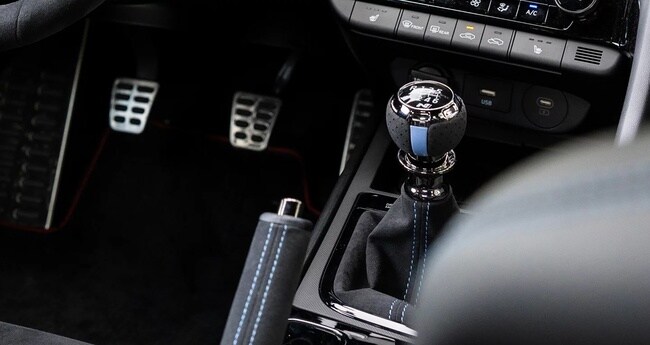
Choosing between the six-speed manual and the eight-speed wet dual-clutch transmission (DCT) on the Hyundai Elantra N depends on whether you prioritize total driver engagement or maximum acceleration. The six-speed manual offers traditional three-pedal control with automatic rev-matching for an authentic sports sedan experience. The eight-speed DCT delivers quicker gear shifts, launch control convenience, and temporary power-boosting software. Drivers seeking rapid lap times or smooth daily commuting should choose the DCT, while buyers who love tactile mechanical feel will find the manual transmission more rewarding.
Both options channel performance through a high-output engine designed to turn standard highway drives into an engaging outing. Navigating local routes near Bedford becomes far more exciting when you have direct control over power delivery. The standard gearshift layout gives purists exact control over gear selection during spirited runs, while the automatic double-clutch layout takes the effort out of heavy traffic along busy commercial corridors.
Choosing the right setup is easier when you can compare both versions in person. You can start by finding our Bedford showroom to inspect the cabin layout and pedal arrangement. Give our knowledgeable team a quick call to learn which versions are hitting our lot this week.
Is the Hyundai Elantra N Faster With the DCT or 6-Speed Manual Transmission?
The Hyundai Elantra N reaches 60 mph faster when equipped with the eight-speed wet dual-clutch transmission, accelerating from a stop in under 5 seconds compared to roughly 5 to 6 seconds for the manual model. Automated clutch control and rapid gear changes allow the DCT to shift in milliseconds without dropping boost pressure from the turbocharger.
Under the hood, both models share a 276-hp turbocharged 2.0-liter four-cylinder engine generating 289 lb-ft of torque. In instrumented testing by Car and Driver, the DCT-equipped Elantra N posted a 0–60 mph sprint of 4.8 seconds and completed the quarter-mile in 13.4 seconds at 106 mph. By comparison, manual models typically record 0–60 times between 5.2 seconds and 6.1 seconds depending on driver launch technique and traction conditions, running the quarter-mile in approximately 13.8 seconds at 105 mph.
While the manual gearbox allows experienced drivers to execute precise heel-and-toe downshifts, the dual-clutch automatic eliminates human delay. The DCT's automated launch control holds launch revs precisely to minimize front wheelspin off the line. If raw straight-line speed and predictable track times are your top goals, the dual-clutch configuration holds a clear performance edge.
You can explore our selection of new Hyundai models to view current trim configurations and available performance packages.
How Long Does N Grin Shift Boost Horsepower, and What Features Are Exclusive to the DCT?
The N Grin Shift feature boosts engine output by 10 horsepower to 286 horsepower for 20 seconds, requiring a 40-second cooldown period before it can be activated again. Triggered by a bright red button on the steering wheel, this feature increases turbocharger boost pressure and optimizes transmission shift aggressiveness for quick passes or track straightaways.
In addition to N Grin Shift, the DCT variant includes several performance software modes unavailable on manual models:
- N Power Shift: Activates automatically during acceleration over 90 percent throttle, mitigating torque reduction during upshifts to maximize power delivery to the front wheels.
- N Track Sense Shift: Evaluates driving dynamics during road-course conditions and automatically selects the ideal gear and shift timing without requiring manual paddle input.
- Steering-Wheel Paddle Shifters: Allows drivers to override automated shifting instantly and hold gear selection up to the engine redline.
These electronic enhancements transform how the vehicle responds during performance driving. Drivers can enjoy full automated convenience during weekday commutes and switch to aggressive manual control using the paddles whenever a back road opens up.
To compare different model years or trade-in possibilities, take a look at our current stock of pre-owned vehicles to see what performance options fit your budget.
Are There Mechanical Differences Like Differentials and Rev-Matching Between Elantra N Transmissions?
Core chassis hardware remains identical across both transmission choices, featuring the standard N Corner Carving Differential to optimize front-wheel traction. This electronic limited-slip differential actively distributes power between the left and right front wheels during cornering, reducing understeer and pulling the sedan tightly through turn apexes.
The primary mechanical differences reside within the clutch assemblies and gear-matching systems:
- Six-Speed Manual: Features a light pedal action, mechanical shift linkages, and standard automatic rev-matching. A dedicated button on the steering wheel allows the driver to turn rev-matching on or off instantly.
- Eight-Speed DCT: Utilizes a wet double-clutch design cooled by oil to manage high thermal loads during aggressive launches and rapid gear changes.
Enthusiasts testing both transmissions on our lot frequently ask whether the automated rev-matching on the manual gearbox can be disabled for heel-and-toe driving, which is quickly done using the dedicated steering wheel button. Both gearboxes feed power into the same rigid chassis architecture, high-performance brake system, and electronically controlled suspension.
If you are evaluating certified options backed by factory protection, check out our certified pre-owned Hyundai options to discover high-quality models that have passed rigorous inspections.
Which Elantra N Transmission Gets Better Fuel Economy and Holds Stronger Rarity Value?
The six-speed manual transmission delivers slightly better official EPA fuel economy ratings, achieving 21 mpg city / 29 mpg highway compared to 20 mpg city / 27 mpg highway for the DCT model. However, real-world highway testing by Car and Driver revealed impressive efficiency for both variants, with the DCT reaching 37 mpg and the manual achieving 32 mpg during steady 75-mph highway cruising.
Save more on fuel without sacrificing comfort during daily highway travel. A commuter heading toward downtown Cleveland via I-271 will appreciate how comfortably the sport bucket seats and refined cabin handle daily traffic. Plus, the interior features an easy-to-use touchscreen paired with a clear digital instrument panel that connects seamlessly to your smartphone.
From a long-term collector standpoint, manual models account for a smaller percentage of total production volume. Because fewer manual sports sedans are built each year, three-pedal variants tend to maintain high interest in the pre-owned market among driving purists.
Keeping your performance vehicle running at peak efficiency requires regular fluid checks and tire rotations. You can easily maintain your car by scheduling service online with our factory-trained maintenance technicians.
Common Questions About the Hyundai Elantra N Transmission Choices
Selecting between a manual gearbox and an advanced dual-clutch transmission comes down to personal driving habits and daily performance needs.
Q: Does the manual Elantra N require premium fuel?
Hyundai recommends unleaded gasoline with an 87 octane rating or higher for daily driving. However, using premium 91 octane fuel unlocks the engine's maximum 276 horsepower and sharpens throttle response during performance driving.
Q: Can you use launch control in the manual Elantra N?
Yes, N Mode Launch Control is built into both transmission variants. Drivers select N Mode on the screen, depress the clutch and accelerator pedals simultaneously, and release the clutch once the engine holds the target launch RPM.
Q: Is adaptive cruise control available on either transmission?
Adaptive cruise control is not offered on the Elantra N regardless of transmission choice. Standard active safety technology includes Forward Collision-Avoidance Assist, Blind-Spot Collision Warning, and Lane Keeping Assist for keeping your family safe on the road.
Q: Does the DCT gear selector make mechanical sounds in low-speed traffic?
Dual-clutch transmissions occasionally produce subtle mechanical clicks during slow parking lot maneuvers as automated actuators engage the wet clutches. This is standard behavior for high-performance dual-clutch gearboxes and does not indicate a mechanical problem.
You can begin your purchase journey from home by filling out our online financing application to contact us for current financing information.
Test Drive the Hyundai Elantra N Today
Experiencing the swift gear changes of the dual-clutch automatic alongside the mechanical feel of the six-speed manual is the best way to determine which transmission fits your lifestyle. Our team is committed to providing straightforward vehicle details, clear trade-in estimates, and financing options available through our team.
You’ll also appreciate how simple it is to test both configurations back-to-back on local roads. Whether you want maximum track speed or the daily involvement of a manual stick shift, we are here to help you drive home in the perfect sports sedan.
Start your performance journey today by visiting our dealership on Rockside Road or getting in touch with our team at (440) 745-7476. If you ever need factory upgrades or maintenance components down the road, our genuine Hyundai parts center carries the exact equipment engineered for your vehicle.
Prices and MSRP referenced in this article are estimates for informational purposes only and do not constitute an offer to sell. See dealer for complete details. Fuel economy estimates shown may differ from official EPA ratings and should not be relied upon as a guarantee of actual vehicle performance.


